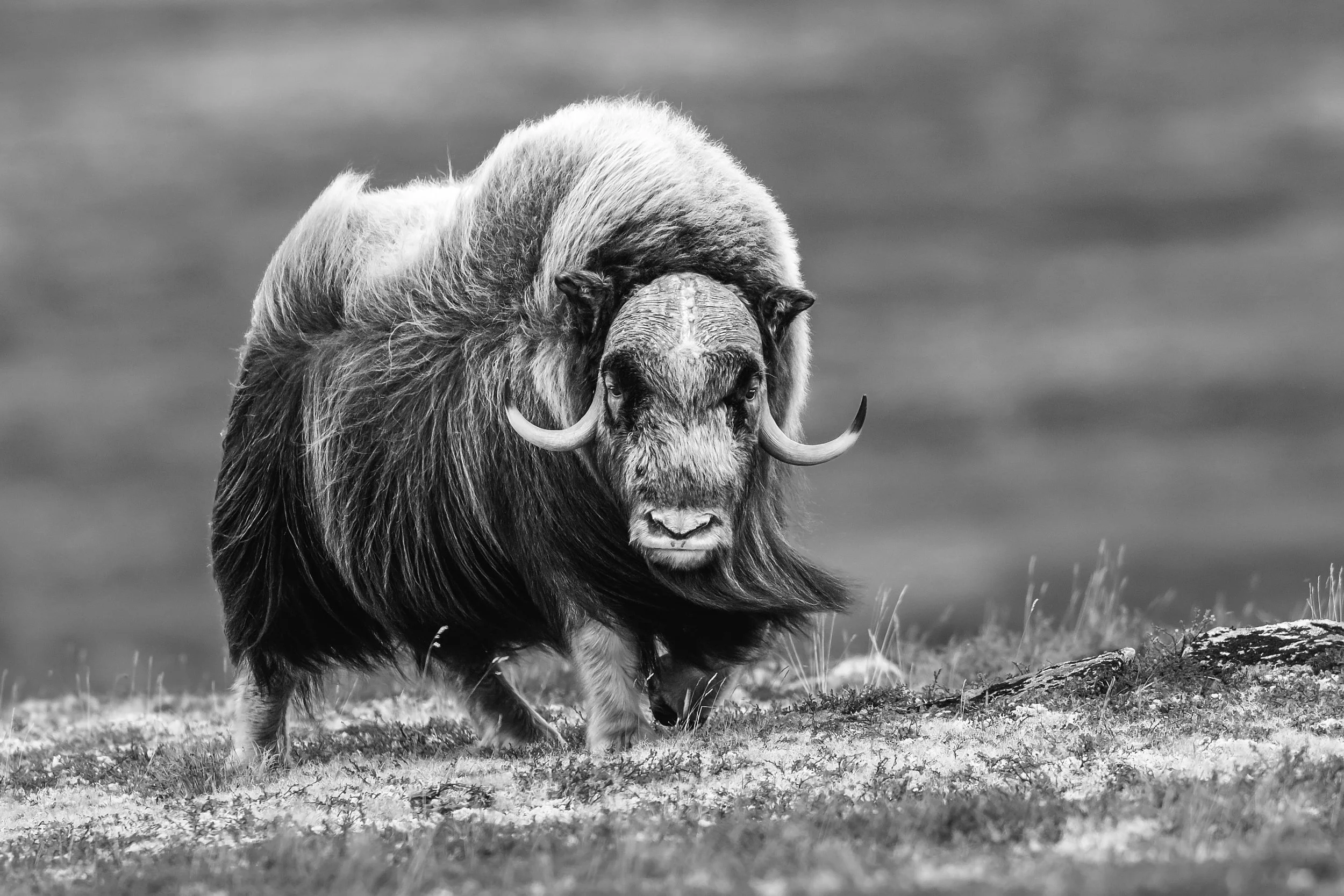
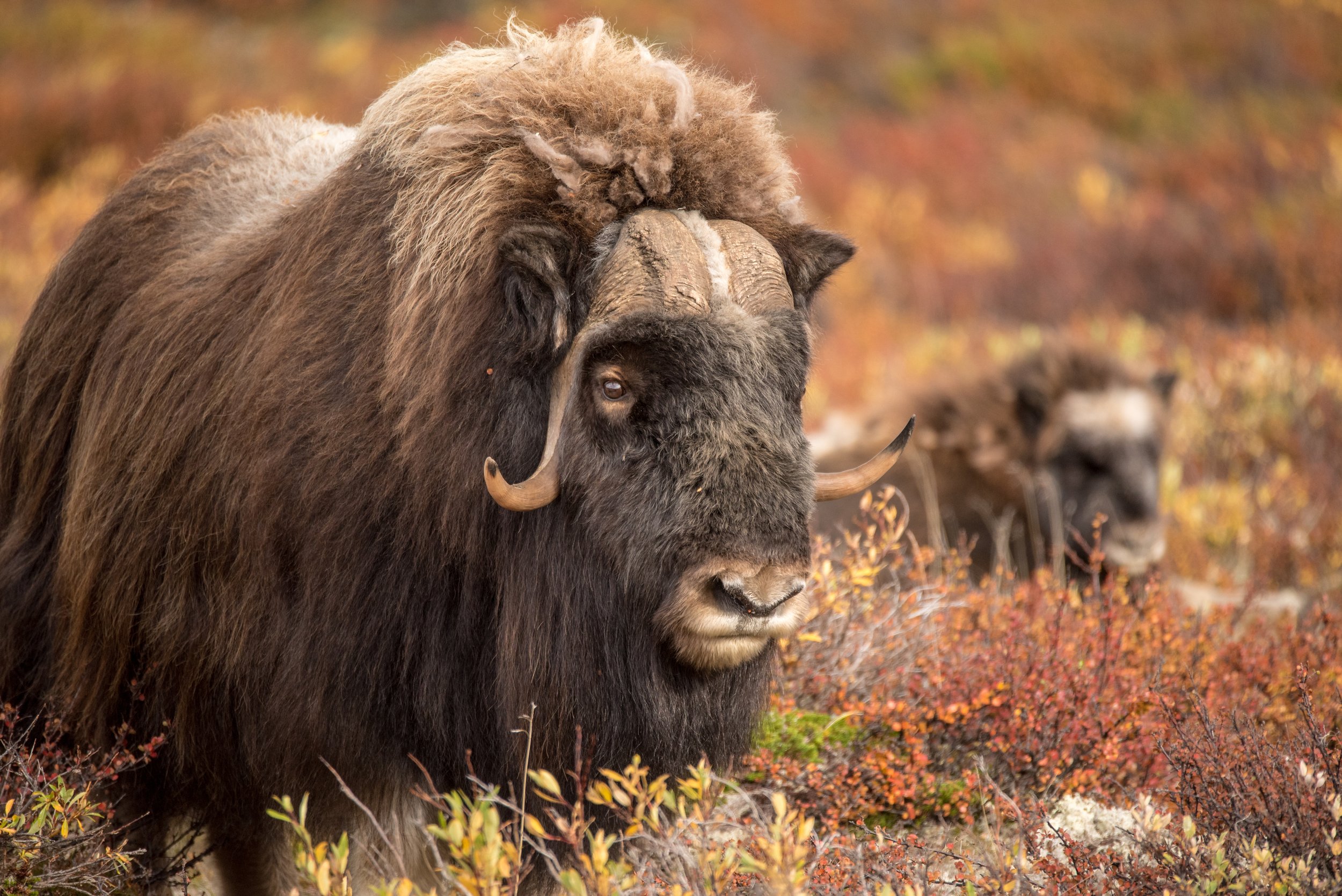
TITANS OF THE TUNDRA: MuskOX IN AUTUMNAL ALASKA
There are landscapes that seem to remember the old world more vividly than the new. The Seward Peninsula, where the Bering Sea breathes cold mist into the hills and the tundra turns to fire each September, is one of them. This is muskox country: wind-shaped, wide-open, and stitched with the migrations of animals that have been here since the Pleistocene.
For five days, we’ll step into that world. Not as spectators keeping our distance from something foreign, but as travelers invited into a place where time slows, sound carries, and the presence of a single muskox can feel like standing in the company of an ancestor.
This workshop is designed for photographers who want more than a checklist image. This is for those who want to feel the landscape under the photograph — the tension of wind against wool, the way the light slides across the tundra, the quiet intelligence of an animal whose lineage survived ice ages and megafaunal extinctions long before any of us were imagined.
Muskox (Ovibos moschatus) are not newcomers to North America. They are survivors of an age when the world was colder, wilder, and shaped by ice. At the close of the last ice age, muskoxen roamed across Europe, Asia, Greenland, and North America, including what is now Alaska.
But by the mid-1800s, muskox disappeared from Europe and Asia, and by the 1920s, they had vanished from Alaska, as well. The only remaining herds survived in remote pockets of east Greenland and Arctic Canada. Global concern sparked at a time when most wildlife losses went uncared about, and conservationists began pulling the species back from the brink.
In 1930, a group of 34 muskoxen were captured in East Greenland and brought to Fairbanks, beginning one of the most successful reintroduction stories in the North. Later, they were moved to Nunivak Island, where the animals not only survived, but flourished in the wind-scoured island in the Bering Sea. By 1968, the herd had grown to about 750 in total.
From that single herd, the restoration of the species began. Musox from Nunivak were released on the Seward Peninsula, the very landscape this workshop is exploring, as well as Cape Thompson, Nelson Island, the Arctic National Wildlife Refuge, and other areas. By the early 2000s, Alaska supported nearly 4,000 muskox.
The breeding season for muskox spans late summer into early fall, with mating occurring between August and October. During the height of the rut, dominant males challenge rivals with head-on charges that can be felt as much as heard, the impact reverberating across the tundra like a struck drum. These battles determine which bulls will control small harem groups of five to fifteen females and sub-adults, guarding them fiercely and preventing other adult males from entering.
arly September is the sweet spot: fall color spills across the landscape, the light sits lower in the sky, and temperatures remain comfortable enough for long photographic sessions. The bulls are beginning to settle after the rut, the harems are established, and family groups move across open ground in a way that allows for patient, respectful, and intimate photography.
Around Nome, muskox inhabit a mosaic of tundra, rolling hills, river drainages, and berry-rich slopes, and this workshop is timed to take advantage of some of the most beautiful colors to wash over the tundra.
Nome also provides something rare in Alaska: road access to photogenic tundra ecosystems. Over the course of the workshop we will travel the Teller, Kougarok, and Council Roads, each one opening additional habitat, ribbons of gravel leading into country that feels impossibly vast. Along the way, the tundra provides other gifts: red fox, tundra swans, moose, the last of the bear activity during hyperphagia, willow ptarmigan in transitional plumage, and sweeping landscapes that seem made for wide-angle storytelling.
The history of the muskox and their lives here shapes the way we photograph them. When a muskox cow glances back over the shoulder of her calf, or a bull stands broadside against a hillside flushed with autumn color, we’re not just documenting wildlife. We’re seeing the living continuation of a lineage restored to the Alaska landscape by human hands, human foresight, and an acknowledgment of our responsibility to the ancient animals who share our world.
On this workshop, you’ll learn to photograph muskox with that full story in mind: not simply as charismatic subjects, but as survivors of the Pleistocene, reclaimed residents of the tundra, and quiet reminders of what can endure when we choose to protect it.
GENERAL INFORMATION
DATES:
September 7 - 11, 2026 (SOLD OUT | JOIN THE WAITLIST)
2027 Dates TBA (Receive an email when dates are announced)
PRICE: $4300
DEPOSIT: $1500
GROUP SIZE: Limited to 6
SKILL LEVEL: Beginners to Advanced
INCLUDED IN PRICE:
Single-occupancy lodging starting the first night of the workshop
Transportation
Breakfast and lunch, along with snacks and drinks in the field
NOT INCLUDED:
Transportation to/from Nome, Alaska
Dinner
Items of a personal nature (e.g., laundry, souvenirs)
Travel insurance (highly recommended)
Incidentals incurred by participants at lodging
PHYSICAL DIFFICULTY:
Due to the distance we travel, we’ll be in a private vehicle for most of the trip, getting out when the photographic opportunities present themselves. There can potentially be some short-distance hikes from the road side, but this is not a highly physical workshop and should be suitable for most fitness levels. Participants should be able to carry their gear unassisted.
INSURANCE:
General travel insurance is highly recommended, but not required.