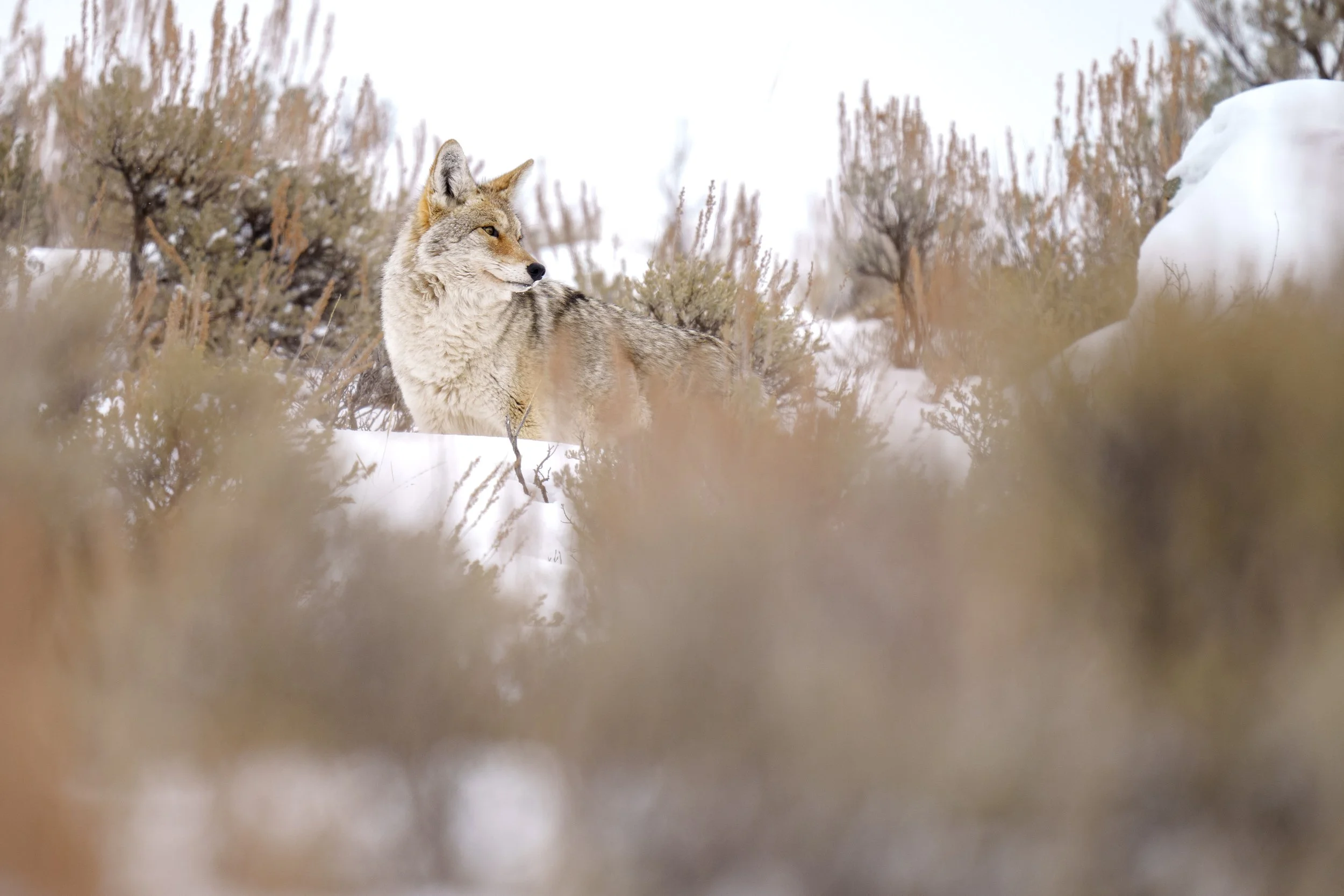
Becoming the Coyote: Lessons From A Year of Survival

The coyote survives because she refuses the script we have written for her.
Before European contact, Canis latrans occupied the grasslands and deserts of western North America. A mid-sized canid perfectly adapted to open country where life was hunting rabbits and rodents and singing to the stars.
She moved through that openness lightly and deliberately, never wasting energy, never lingering where hunger or danger might find her first. Coyotes learned early on that survival in exposed country depends on vigilance. On reading wind and distance, on knowing when to move and when to disappear, and on making decisions shaped by scarcity rather than abundance.
Then we arrived, along with our certainties about how the world should be ordered, about which animals deserved to stay and which needed to go.
We declared war.
Poisoned baits scattered across millions of acres. Steel traps set along every game trail. Rifles always trained on animals running full-tilt across the sagebrush flats. The federal government spent decades and untold millions trying to erase the coyote from the landscape entirely, trying to silence that wavering howl we find so unsettling in the darkness.
What went unseen was the work she was already doing — keeping rodent populations in check, cleaning up carrion, stitching together an ecosystem we were actively unraveling. We mistook her presence for disorder, when in reality she was one of the few remaining threads holding the system together.
The coyote responded by penning a story that runs opposite the familiar arc of slaughter: near extinction, small recovery. Under the same kind of pressure that pushed wolves, grizzlies, and other Great Plains animals to the brink, coyotes expanded geographically, numerically, and behaviorally.
When you kill the breeding pair, the remaining females don’t collapse into chaos. No, their bodies respond with larger litters. Where coyotes once bore four or five young, they began producing eight, nine, ten. Reduce their population and they expand their range. Push them out of the plains they’ve always known and they slip into the forest. Poison them in the West, and they appear in the streets of Chicago, the suburbs of Boston, and the barrier islands of the Atlantic coast.
They learned our schedules, our blind spots, and our habits. They shifted their lives into the hours when we sleep, moving along railroad corridors, drainage ditches, and greenbelts. They use the narrow, forgotten seams of our cities the way they once used game trails across the plains. They learned to live in the margins we created, and to thrive in the places we overlook.
Today coyotes inhabit every state except Hawaii, their range having tripled since we first tried to eliminate them. We threw everything we had at their extinction, every tool and weapon and every ounce of ingenuity.
They didn’t just survive. They flourished. Coyotes are a favorite animal of mine, so I’ve been thinking about this a lot lately.
About what the coyote knows that we keep forgetting: that the ability to adapt isn’t about changing who you are. It’s about refusing to let anyone else’s limitations define what is possible for you.
About what it means when someone else’s vision of your life becomes the only map you’re allowed to follow.
About finding yourself in territory you never chose, with boundaries you didn’t set, wondering how you ended up so far from where you were meant to be. About whether to keep insisting on the old territory or learn to read a new landscape entirely.
About realizing the only way out is through.
I'm also recognizing the lessons the coyote has already taught me. She knows that survival has nothing to do with physical strength, that endurance comes from somewhere deeper, somewhere more essential. I learned this over the summer, sitting beside a bed, watching someone I love face what was coming with more grace than I knew was possible.
This summer, in a rare span of time without any travel on my calendar, I cared for my aunt in home hospice. The kind of care where you know how the story ends but show up anyway because love insists on it.
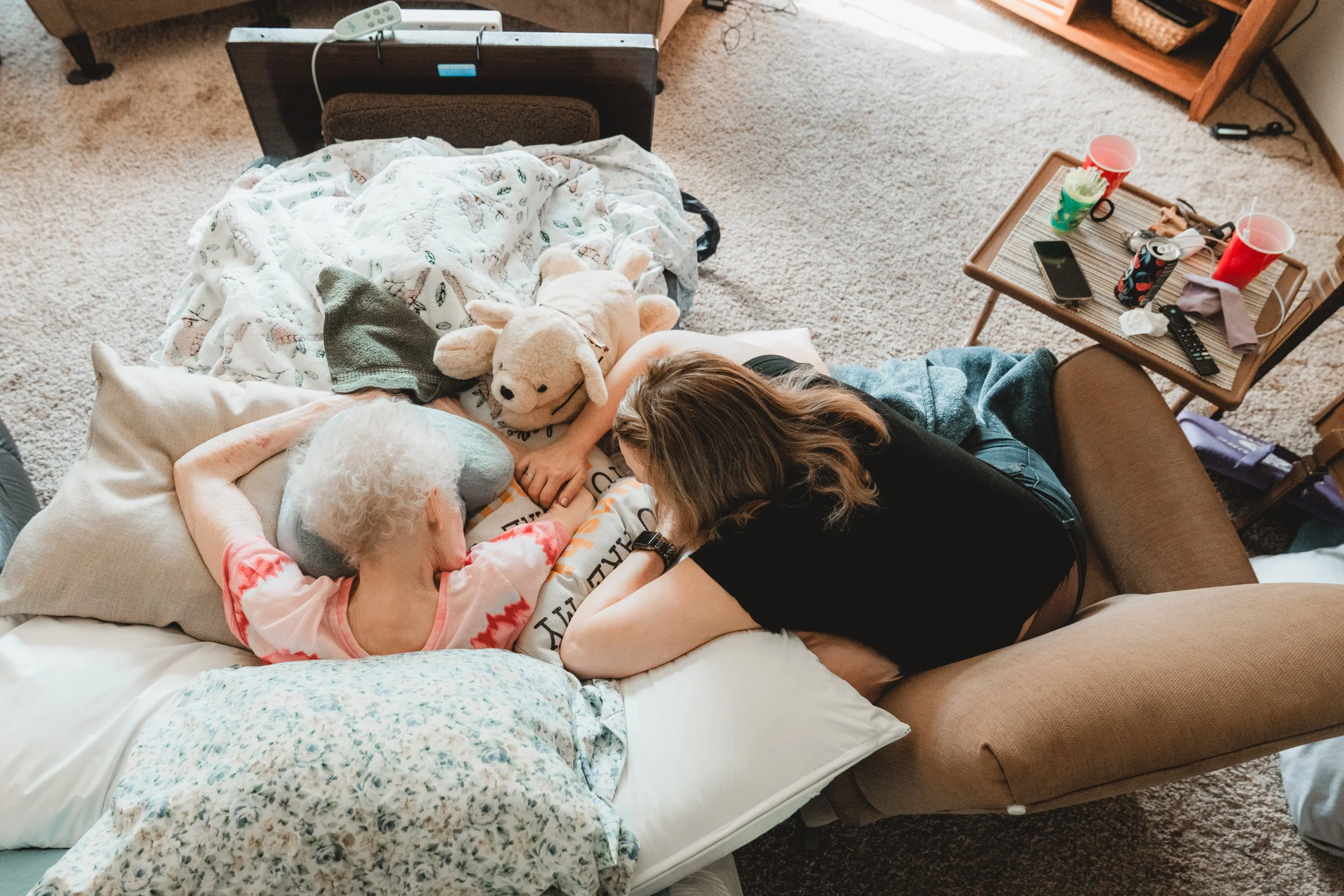
“The Cruelest Clock,” from my series on home and hospice care
Checking vitals, adjusting pillows, managing medications that you know will buy some comfort but not time. My cousin and I traded shifts, held her hands, sat with her through the long afternoons. Some days the weight of it all felt unbearable — watching someone you love diminish to a fraction of who you know them to be, yet there is nothing you can do to stop it.
One morning, when her lucidity was just beginning to waver, she reached out and grabbed my fingertips. Not my hand, just the tips of my fingers. She made one of her signature witty quips and flashed that smile I’d known my whole life. It lasted maybe ten seconds before the fog began creeping back in. But in the moment, I was seen. Fully seen. It was a feeling I had long since forgotten, and I was reminded that joy doesn’t abandon us just because darkness shows up.
My photographs from those weeks captured more feelings that I’d forgotten existed. What it looks like when people show up for one another without conditions, without keeping score, without holding back. My aunt’s community and my cousin’s friends rallied around them, around us. They demonstrated the kind of love I’d been starving for without realizing it.
Caring for her was an in-my-face reminder of what life is supposed to look like. What it means to be valued. What it means to matter to someone. What it means to be enough. It held the mirror to my face and helped me see what I’d been refusing to see for far too long.
Sometimes that kind of clarity comes not from grand revelations, but from quiet observation. From learning to read what is actually in front of you rather than what you wish were there. The coyote understands this instinctively. I’ve watched and photographed coyotes long enough to see their intelligence and adaptability play out in front of me many times over.
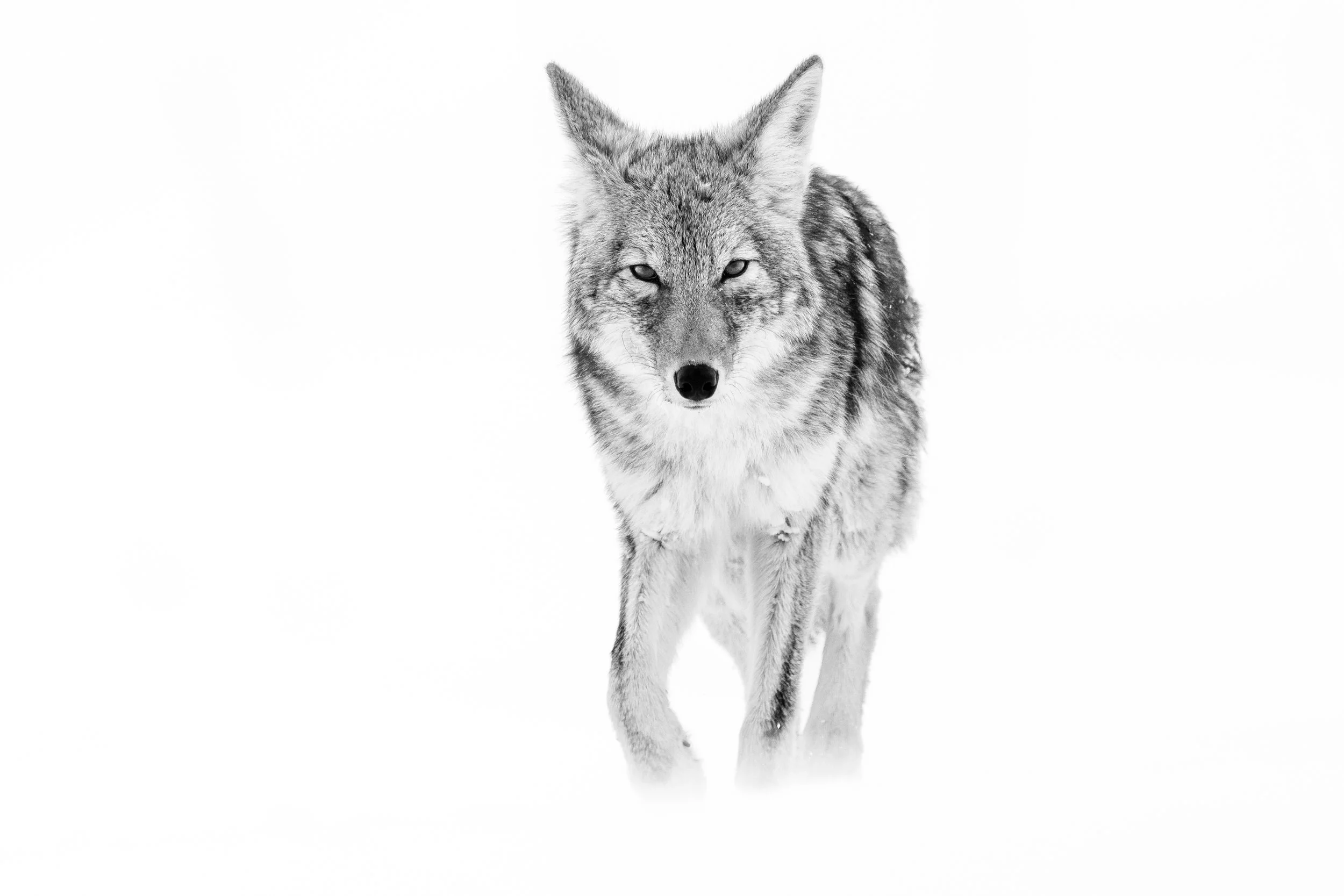
Once, in Yellowstone, I lied motionless in the snow while a coyote worked her way toward me. She knew I was there. Our eyes had connected multiple times. But she assessed the situation and determined I wasn’t a threat, trotting so close to me that I could see the individual hairs along her spine.
She was curious about me, but unafraid. She’d learned to read humans, to sort out the dangerous from the benign, and she decided I belonged in the latter category.
What struck me most wasn’t her proximity but her confidence.
She knew exactly who she was, what she needed, and she refused to let my presence derail her from it. She had a territory to patrol, food to find, and a life to live. I may have been interesting, but ultimately I was irrelevant to her purpose. She also knew something else: when not to react. When stillness was the smarter choice. When energy was better conserved than spent proving a point.
I thought about this observational lesson a lot this fall, when my life came apart in a couple of ways that I am still processing.
I spent years building something I was proud of, something I believed was solid — a business, a partnership, a future. I believed in it the way you believe in the ground beneath your feet. It was built on shared effort, a sense of adventure, and a long-view belief in what we were creating together. It was the kind of work that grows slowly and had purpose.
And then, without warning, the years of hard work and stability were yanked out from underneath me for something fleeting, without the weight of responsibility. A choice driven not by necessity, but by the momentary pull of novelty.
The coyote understands what some never do: proven ground that has fed you season after season is rare, irreplaceable, and worth defending. The coyote knows that straying toward adjacent ground that promises ease or excitement often holds only regret and nothing of substance.
The coyote is often a solitary animal, but she knows when pack matters. When survival requires showing up for one another, when presence becomes essential. This year brought moments that tested exactly that. Moments when I was genuinely afraid, when vulnerability required a pack member simply being there. I reached out to that part of my pack only to find I had been running alone for months.
The coyote doesn't fight against what's made clear. She reads the landscape, accepts what it tells her, and adapts
That's what I finally am learning to do.
The coyote didn't see displacement as defeat. She saw it as expansion. When we tried to eliminate her from the West, she looked east at forests she'd never inhabited and recognized opportunity. New resources. New territory. New possibilities. So she didn't just survive; she tripled her range, claimed an entire continent, brought all her skills into landscapes that had never known her and she made them flourish.
These last few months, I’ve been doing exactly that — expanding into new territory with everything I know and bringing with me all of my bruised-up heart. The workshops I'm creating draw on years of experience but reflect my actual priorities: the destinations that excite me, the techniques I'm passionate about teaching, and the kind of experiences I want to give people.
I'm reaching out to new collaborators and partnering with those whose vision aligns well with mine. And I have projects in motion for 2026 that feel both terrifying and exactly right all at once. What's emerging feels both entirely new and deeply rooted in who I have always been.
The coyote thrives not by being the strongest or the fastest, but by being relentless. By refusing the limitations others impose. By understanding that resilience means claiming new ground, not clinging to old territory that no longer sustains you.
This year has devastated me. It has been one of the hardest, most grief-filled, most heart-wrenching years of my life. I have cried more than I knew was possible. I have questioned everything. I have felt lost and betrayed and furious and broken.
But I have also reclaimed something essential: the clarity to know when something isn't serving me. The courage to walk away from what I know makes me smaller in the end. The understanding that life is too precious for those who haven't yet learned what the coyote teaches: that if you don't pay attention to what you have, you will lose what you can't replace.
So as this brutal year finally, mercifully comes to a close, I want to thank you. For staying with me through these months. For opening these emails even when I disappeared into grief and reinvention. For reminding me about the world we share through your messages and your presence and your curiosity. For reminding me that there is still wonder waiting. That there are so many incredible adventures to be had.
The coyote survives because she refuses to give up. She keeps moving, patrolling the edges, testing boundaries, adjusting her route with the season and the pressure of what surrounds her. When the landscape changes, she doesn’t argue with it. She reads it. And then she walks on. Because she adapts, learns, changes, and persists. Because she sings into the darkness and trusts that the song matters, whether or not anyone answers.
I'm still moving. Still singing. Still adapting to this new territory.