When Familiar Places Become Strange (and why that’s good)
The thermometer read fifty-three degrees when we pulled into the Lamar Valley just as dawn was breaking. Fifty-three degrees. In late December. In Yellowstone.
I stood there in one of the pull-outs, wearing a winter parka I didn’t need, staring out at a landscape I barely recognized.
For the last five winters, I’ve been bringing groups of photographers to this place. I know the rhythm of it, the way the deep snow pushes moose down from the mountains, the white expanse of the valley floor punctuated by dark shapes of bison, the steam from the thermal water rising against snow-laden ridges. I know where to position people for the best light on a frosty morning, which pullouts are best for clean backgrounds in every part of the park, and how to read the behavior of a coyote at two hundred yards out and know whether we should move closer or hold still.
But this wasn’t that Yellowstone.
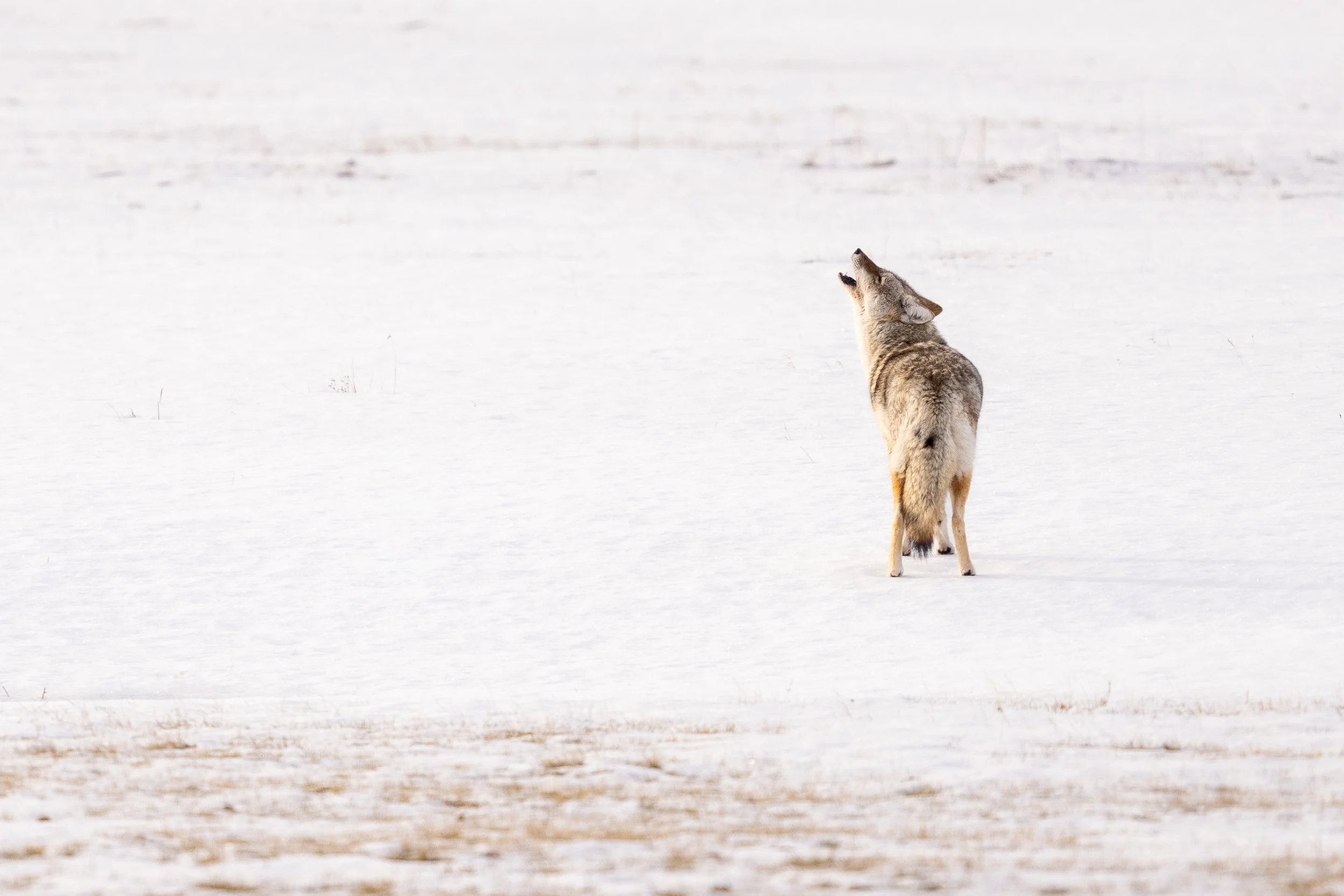
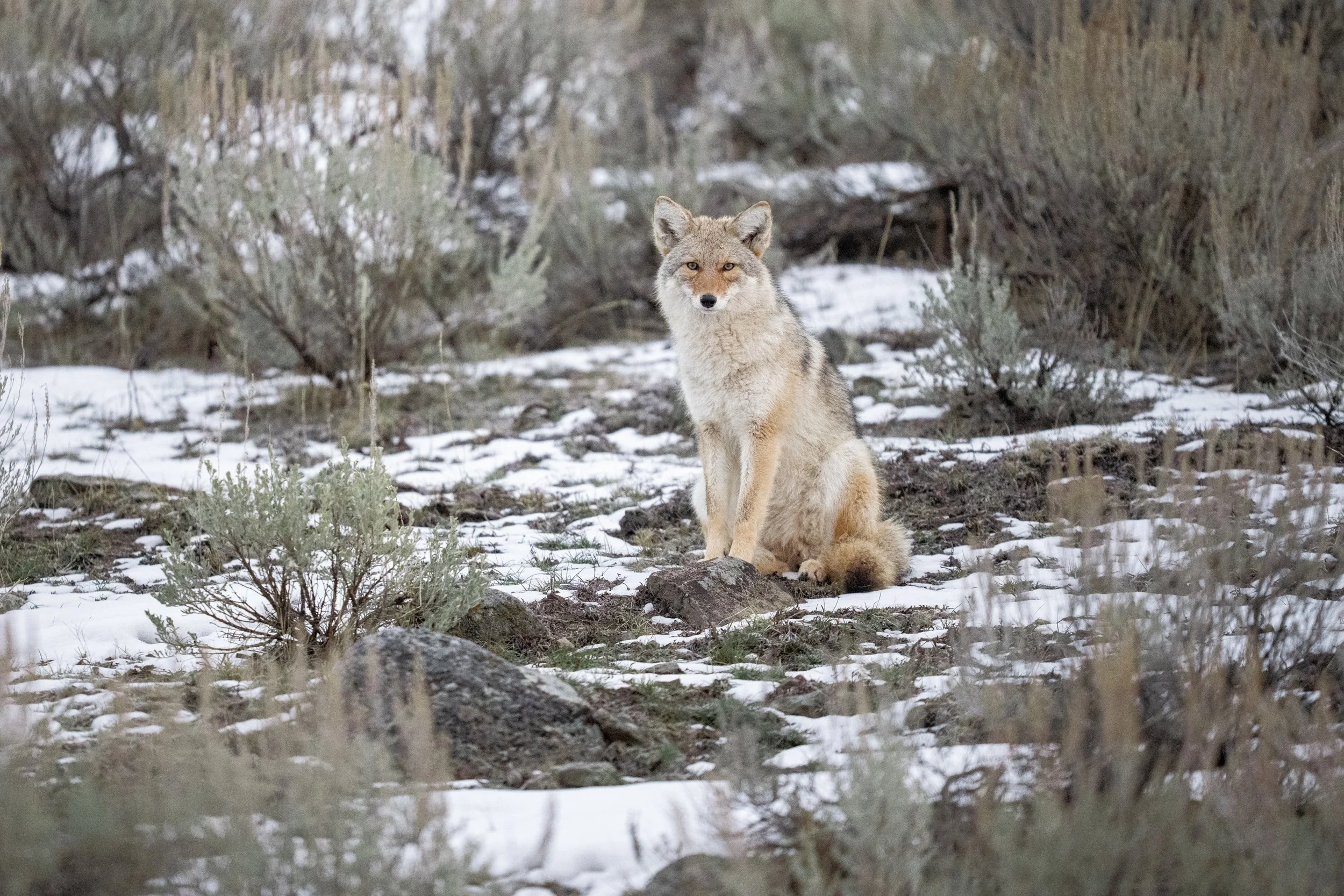
Where I expected at least a couple of feet of snow, I found bare ground. Mud pools reflected back to me the pale winter sky. The sagebrush stood exposed, from the top of its silver-gray branches to the roots diving deep into the dirt. One day we watched a trio of coyotes bedded down on a thin blanket of white. The next morning, that exact spot was mud, dark and wet. Any evidence that there had been any snow was completely gone overnight.
I had been worrying about the weather for a solid week now. My obsession with the weather in this particular park doesn’t start until about ten days ahead of arrival. My experience in Yellowstone has taught me that it’s too volatile to see anything remotely resembling an accurate forecast any earlier than that, and the general weather-related anxiety that I carry as a wildlife photographer has taught me that there is no use being anxious ahead of time over hypotheticals — save all the anxiety for one big push before you arrive.
Naturally, my first thought was worry. It wasn’t just a lack of snow in the valley that concerned me. It was the lack of snow up high that drove the weather-related anxiety this year.
Where most people look at weather forecasts to plan what to pack, if they’ll need extra layers, or get a sense of road conditions, I look at forecasts through an entirely different set of lenses. When I see fifty-degree temperatures forecast for late December in Yellowstone, I’m not thinking about my own comfort. I’m thinking about the snow depths at 8,000 feet. I’m thinking about how ungulate (hoofed mammal) distribution patterns shift when the normal environmental cues are scrambled.
You cannot reach the next level in this craft without first becoming a naturalist. The camera is a tool for documenting what your ecological knowledge helps you find and understand and translate into a visual language. You have to know how animals live, what drives their behavior, how weather and seasons and food availability and social structure all interweave and become an invaluable part of your kit.
You have to think like a biologist before you can create like an artist.
In a typical Yellowstone winter, snow accumulation in the higher altitudes follows a predictable pattern that shapes the entire ecosystem. As snow depths increase above 8,000 feet, they begin to restrict access to browse for moose. Moose, despite their long legs and ability to move through deeper snow than most other cervids, eventually find the energetic cost of foraging in the deep powder too high.
When the snow depths reach two or three feet in the subalpine forests where they summer, the willows and other woody browse they depend on become increasingly difficult to access.
The math here is simple: the calories burned breaking trail in the snow to get to that food eventually exceed the calories gained from feeding. So they descend, moving down into the valleys where the snow is shallower and the willows grow in abundance and are far easier for the moose to browse. It’s a pattern that allows wildlife photographers to plan with a fair amount of predictability.
For bull moose, this timing is especially critical. The rut, which peaks in late September and early October, extracts a savage toll on their bodies. Bulls spend weeks in a state of near-starvation, so consumed with breeding that they barely eat. They travel constantly, seeking receptive cows, fighting rival bulls, and expending enormous amounts of energy in displays and combat.
A mature bull moose can lose 20-30% of his body weight during the rut, burning through the fat reserves and even muscle mass in service of reproduction. By the time the rut ends in late October, these bulls are gaunt, exhausted, and depleted just as winter begins to tighten its grip on the high country.
The first few weeks of December become a race against time. They need to feed intensively, rebuilding fat stores before the deep cold and heavy snow arrive with the new year. If they have to expend too many calories breaking trail before they’ve recovered from the rut, they may not survive until spring. This elevational moose migration, this descent to the lower valleys where feeding is easier for them isn’t just a convenience. It’s a biological imperative that can mean the difference between starvation and survival.
So this winter, with snow barely touching the tops of the mountains, the plot took a twist and I wasn’t entirely sure how it would resolve. Without snow accumulation up high, would the moose and bighorns even bother coming down yet? Would the smaller prey animals be harder to find for the coyotes and foxes? Would this trip be a bust, months worth of anticipation for a week of pure photography dissolving into a landscape emptied by unseasonable warmth?
I've learned, over years of this work, to trust patterns. Winter in Yellowstone follows certain rules. The snow deepens. The ungulates descend. The coyotes and fox mouse in spectacular pounces. The bison plow the deep snow with their faces and large shoulder muscles. These are reliable rhythms, the kind you build expectations around.
But sometimes, I'm learning, the disruption of our expectations is exactly what we need.
Because despite the missing snow, despite my concerns, we saw more bull moose than I've encountered in any of my other trips to Yellowstone. They were there, spread across the valley in numbers that surprised me, browsing on willows that would normally be half-buried in snow, in temperatures well above their thermal comfort zone. The landscape had changed in ways I hadn’t seen, and the wildlife had adapted to it in ways I hadn't predicted.
But here’s the thing that actually made the trip different than all the others: for the first time ever, I wasn’t here as a guide with a workshop, I was just here.
When you guide a wildlife photography workshop, your attention splinters into fragments. You’re watching the animals, yes, always, reading the body language for all of the clues of stress, or tolerance, or indications of other wildlife nearby. But you’re also watching your clients, making sure no one is about to slip on ice, pushing their physical limits too far, and ensuring the person on the end isn’t drifting into an unsafe position or will spook the animal and ruin it for everyone else. And you’re always reminding people that “quiet” in human terms is still a decibel level equivalent to a Metallica concert to the rest of the animal kingdom.
You’re thinking about backgrounds, about the light, about reminding people not to blow out their blue channel, and you’re anticipating what that animal will do in the coming seconds and minutes so you can make sure everyone else is ready for it. And, you’re worried about what other groups are doing (or not doing) and how their behavior will impact everything your group will experience, too.
As a guide, you’re managing the experiences of six different people simultaneously, trying to make sure everyone gets what they came for. It is work that I love, and I am good at it, but it requires a particular kind of divided awareness that doesn’t leave much room for your own creative exploration.
A good guide and leader knows it’s about getting the shot for their clients, not themselves. That’s the job. It’s why being a good photographer is actually the least important part of what I do. That’s what I signed up for and I do not resent it in the least. Seeing another photographer nail a dream shot on one of my trips is like winning an Academy Award.
But it does mean that for the last five winters, I’ve been experiencing Yellowstone through a lens of responsibility, of group dynamics, of making sure everyone else’s needs are met. And on this trip? I didn’t have to think about any of that.
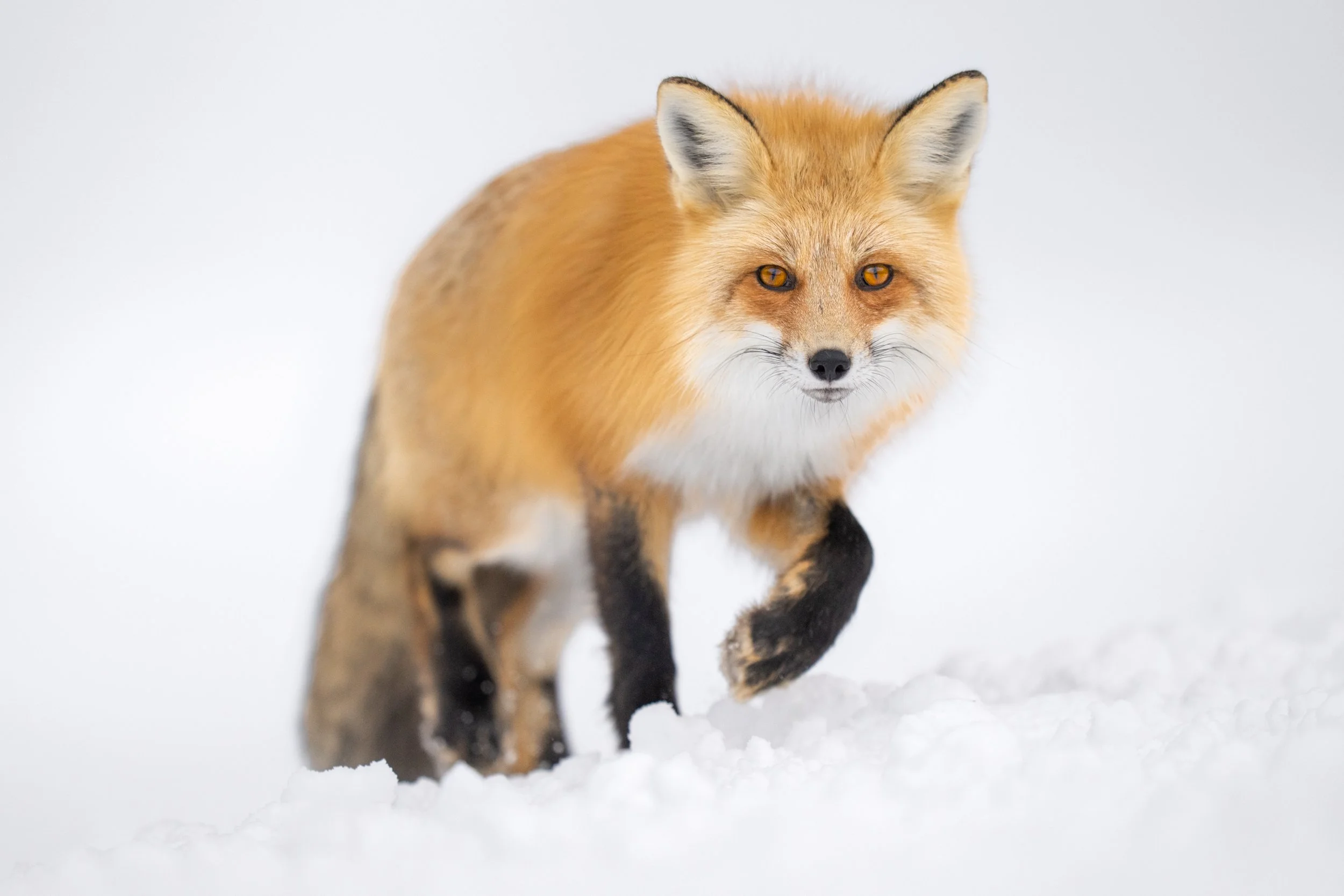
I've watched my clients photograph red foxes while I managed logistics of the vehicle and everything else. I've seen the habituated red fox in Cooke City plenty of times, the one that lives near the house where people feed it, the one that every photographer in the park has photographed and seemingly every tour leader relies upon to guarantee a photo. But I'd never had the chance to photograph a truly wild fox in Yellowstone, not one that chose to be there with me rather than one that had learned humans meant an easy meal. Not until this trip.
On the road to Cooke City, winding through country where the snow had held better than in the valley, a red fox materialized from the forest like something conjured. She moved across a snow-covered meadow with that characteristic fox gait, purposeful and light. She spotted us and instead of melting back into the forest, she approached.
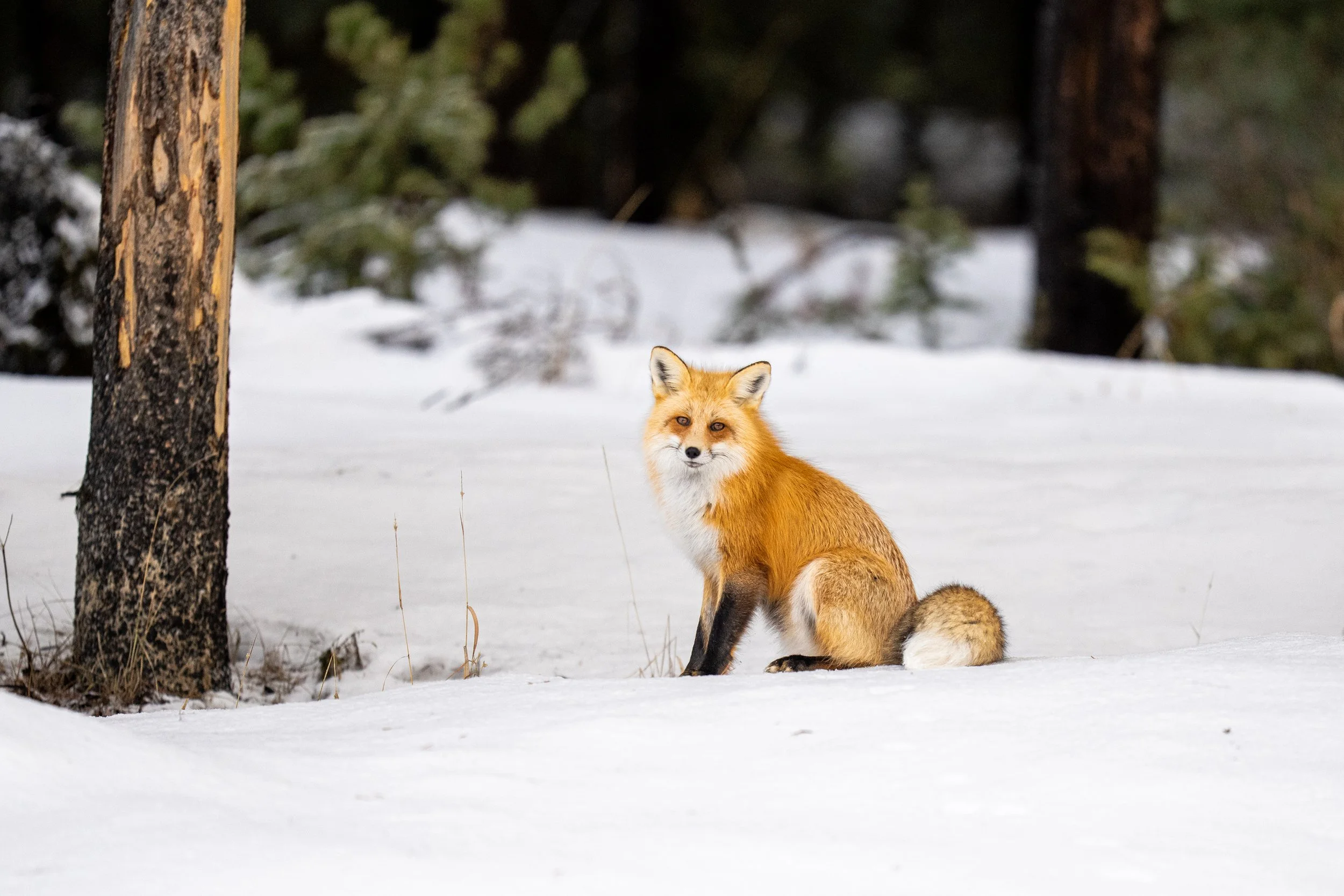
This wasn't the habituation of the town fox. This was curiosity meeting respect, wildness choosing to investigate rather than retreat. She came within ten feet and stopped, staring directly at us, her ginger coat brilliant against the white of the meadow, the black on her legs sharp as ink marks, her eyes holding mine with an intelligence that felt mutual.
We looked at each other for several minutes, time doing that strange elastic thing it does in moments like these. Then she turned and trotted off, pausing once to glance back before dissolving into the forest. It was just us and her and the winter silence, and for the first time in five years of bringing people to this place, I got to be fully present for an encounter like that with my camera in hand and no one else's experience to manage. It was such a treat, the perfect Christmas gift from Mother Nature!
We were able to sit with the fox and let the encounter unfold at whatever pace it was going to unfold. I could wait, as long as I wanted if my creative instinct suggested it might be worth the effort. I could hike back into areas that my guiding permit doesn’t allow me to access with groups.
I could be patient and focused in a way that guiding rarely permits.
And because the landscape itself had shed its familiar white coat, because the conditions were so different from what I expected, I had to see everything differently. I couldn't rely on the high-key winter aesthetic I'd grown accustomed to, the clean simplicity of dark animals against white snow. I had to work with browns and grays and the tawny gold of dormant grasses. I had to find compositions that honored this transitional landscape, this in-between moment when winter was trying to arrive but couldn't quite manage it.
It forced me to abandon the photographs I'd already composed in my mind and see what was actually in front of me.
I've been thinking about this a lot since I got home. About how we develop patterns, not just in photography but in how we move through the world. We return to the same places and see them the same way. We photograph the same subjects with the same approaches and techniques. We stop really looking because we think we already know what we're going to see.
In wildlife photography, this often shows up as a particular kind of image. Tight portraits, the animal filling the frame, everything about the photograph announces technical prowess.
“Look how close I got.” “Look how sharp this is.” “Look what I did.”
These aren't bad photographs. Technically, they might be excellent. But they tell the same story over and over. They say "I saw this animal," and then they stop talking.
The truth is that a white-tailed deer in a tight headshot looks pretty much like every other white-tailed deer in a tight headshot. An eagle on a branch, frame-filling and sharp, looks like all the other frame-filling eagles. We collect these images like proof of presence, evidence that we were there and the animal was there and we had the right equipment to document it. But we stop asking what else the photograph might say.
What else is happening in this moment? What's the relationship between this animal and its habitat? What does the quality of light tell us about the time of day, the season, the weather moving in? What does the animal's behavior reveal about its life, its needs, its wildness?
I keep thinking about my own familiar places. As a workshop leader, I go to many of the same places each year. There’s a reason so many of us take our groups to the same national parks and refuges and lodges, and destinations. They’re reliable year after year, and I know with a reasonable certainty that I can help clients traveling with me take home incredible photos that will make their trip worth the investment.
So. What am I not seeing in those places because I think I already know what's there?
As we move into a new year, I want to invite you to sit with that question, too. Not as judgment, not as criticism of the photographs you've already made, but as an opening. What are the places you return to again and again? What are the subjects you photograph repeatedly? And more importantly, how might you see them differently?
Maybe it means visiting a familiar location at a different time of day, or in weather you'd normally avoid, or in a season when you've never been there before. Maybe it means deliberately leaving your longest lens in the vehicle and forcing yourself to work wider, to include context, to tell bigger stories. Maybe it means sitting with a scene longer than feels comfortable, waiting for behavior instead of settling for presence, trusting that patience often reveals things that haste overlooks.
Maybe it means recognizing that the photograph you've made a hundred times doesn't need to be made again, at least not the same way.
Photo by: Matt Duboff Photography
The conditions that disrupted my expectations in Yellowstone turned out to be a gift. They forced me to abandon my preconceptions and engage with what was actually in front of me rather than what I expected to be there. They pushed me toward different compositions, different stories, different ways of thinking about a landscape I know intimately.
You don't need unseasonably warm weather or melting snow to give yourself that gift. You just need to ask, as you stand in the entryway of 2026, how can I make this time different?
Your familiar places are waiting to be seen again, as if for the first time. The animals you've photographed before have more stories to tell than the ones you've already captured. Your archive is probably full of tight, sharp portraits, and that's wonderful, that's part of the journey. But what else is possible? What haven't you yet said?
I'm going into the new year asking myself these questions and so many more. And while I’ve always been pretty good about reflecting on my work, I’m looking at my own archive with fresh, honest eyes, identifying the patterns I've fallen into, the stories I've told and retold, and asking what remains unspoken. I'm thinking about how I can challenge myself to see differently, to work differently, to make images that do more than document that I was present when an animal was present.
I'm wondering what your photography might look like if you did the same.
The fox in the meadow didn't owe me anything. She could have fled, and no one would have blamed her. Instead, she chose curiosity. She came close enough to look me in the eye, to assess me, to decide for herself what I was. In that moment, we were both fully present, both seeing each other without the filters of expectation or habit.
That's what I'm after in 2026. That quality of attention. That willingness to be surprised. That commitment to showing up without assuming I already know what I'm going to find.
The Lamar Valley will still be there next winter. The coyotes will still hunt voles in the snow. The moose will still browse on willows. But I'll be different because I've remembered how to see, really see, instead of just looking for what I expect to find.
Here's to the year ahead, and to looking at old places through new eyes.