Many People Photograph Wildlife, But Few Actually See It

A redhead drake (Aythya americana) makes his way around the marsh during an early, foggy morning on May in the Prairie Potholes Region of North Dakota. This glacially-carved region, which spans from the northwest corner of Iowa northward into Canada, is where more than half the continent’s waterfowl are born every year. With more and more of this sensitive landscape being lost to agriculture, species who rely on this area for nesting are experiencing rapid population declines and have drawn renewed focus from conservation groups.
The prairie potholes of North Dakota don’t show off. They sprawl instead, quiet, low, and unassuming, like a secret someone whispered into the land and then walked away. And yet, for so many, this landscape is nothing short of sacred.
For the month of May, I folded myself into that sacred space. Not metaphorically, but quite literally: into a floating blind in the middle of these shallow, glacial-carved wetlands. I traded solid ground for mud and cattails, sleep for exhaustion, and the hum of daily obligations for the wingbeats of redheads, blue winged-teals, and Northern shovelers—all arriving as they have for millennia, drawn to this mosaic of water and grass and sky.
This kind of photography, the kind I love most, is rooted not in pursuit of technical mastery but in pursuit of understanding. It’s about learning to see—not just with your eyes, but with your body, your breath, your patience. It’s about listening to what the marsh is telling you and trusting that if you are quiet enough and still enough, the wild will embrace you.
Here, maybe, is where I write plainly about what this kind of work is—and what it decidedly is not.
This isn’t the workshop circuit, where the bears by the roadside or the elk in the meadow have grown so familiar with human presence that they no longer lift their heads when a dozen tripods unfold. This isn’t your typical bird photography setup with carefully curated perches and nearby feeders, where the background is carefully chosen and the behavior—while still fascinating—is often predictable rather than encountered.
No, out here in the prairie potholes, the birds still remember.
They remember what we’ve taught them about humans across centuries: that we are not to be trusted. And who could blame them? These are birds that have been shot at from the prairie grasses of Saskatchewan to the agricultural fields of the east coast. Generations of wariness are stitched into their bloodlines—these birds know the signature of danger and they do not forgive it.
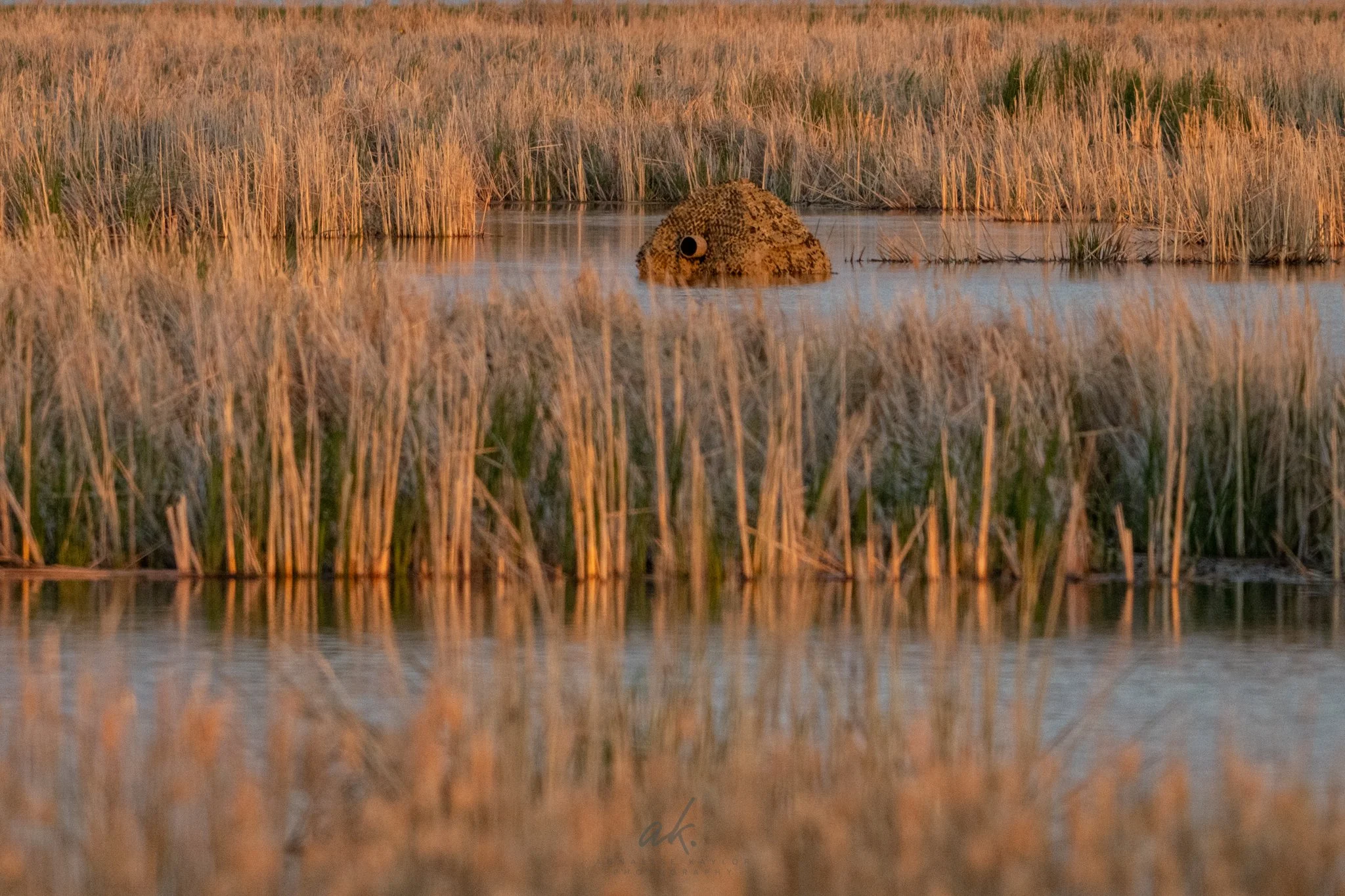
Photographed at dusk, one of the workshop participants heads back to our launch point in their floating hide after an evening out in the water.
Photography from a floating blind is a lesson in restraint. You move too fast, and the ripples betray you. You twitch when the carp smack against your legs and the teal flare skyward. There are no second chances here. No forgiving subjects. No one waiting on you to get your settings dialed in. Every inch forward in the blind is a test. Every minute you sit still without causing a stir is a silent negotiation.
Fieldcraft is the currency here. You are not entitled to a single frame.
That’s the truth of this work. It’s the kind of work that winnows you. And that’s part of the point.
And I’ll be honest with you—this kind of photography is not for everyone. This isn’t where you go for volume. It’s not a place for those who need the instant gratification of an LCD screen full of wins. You won’t walk away from this kind of shoot with memory cards overflowing. Most days, you’ll be lucky to get a dozen frames that might be worth keeping.
But the images that do come? They’re different. Not because they’re technically better, but because they are born of restraint, understanding, and a kind of mutual tolerance that can’t be bought or driven up to on the roadside of a national park. They are hard-earned and, for that reason, heavy with meaning.
I don’t say this to disparage more accessible forms of photography. There’s real value in places where people can safely and respectfully learn, and not everyone can withstand the physical nature of this type of work. But this—this is the deeper water. This is where you go when the photograph isn’t the reason for the experience, but the result of it. This is where the camera becomes the last part of the process, not the first.
Fieldcraft is the currency here. What matters most is your knowledge of the land, your reading of the birds. You instinctually must predict, not pursue. You must see the difference between a feeding posture and a threat display. You know when a drake redhead is about to lift off—not because you saw him shift, but because of the way the hen turned her head and tightened her wings just a second earlier. You no longer track with your autofocus system, but with your whole nervous system, attuned to the rhythm of the marsh.
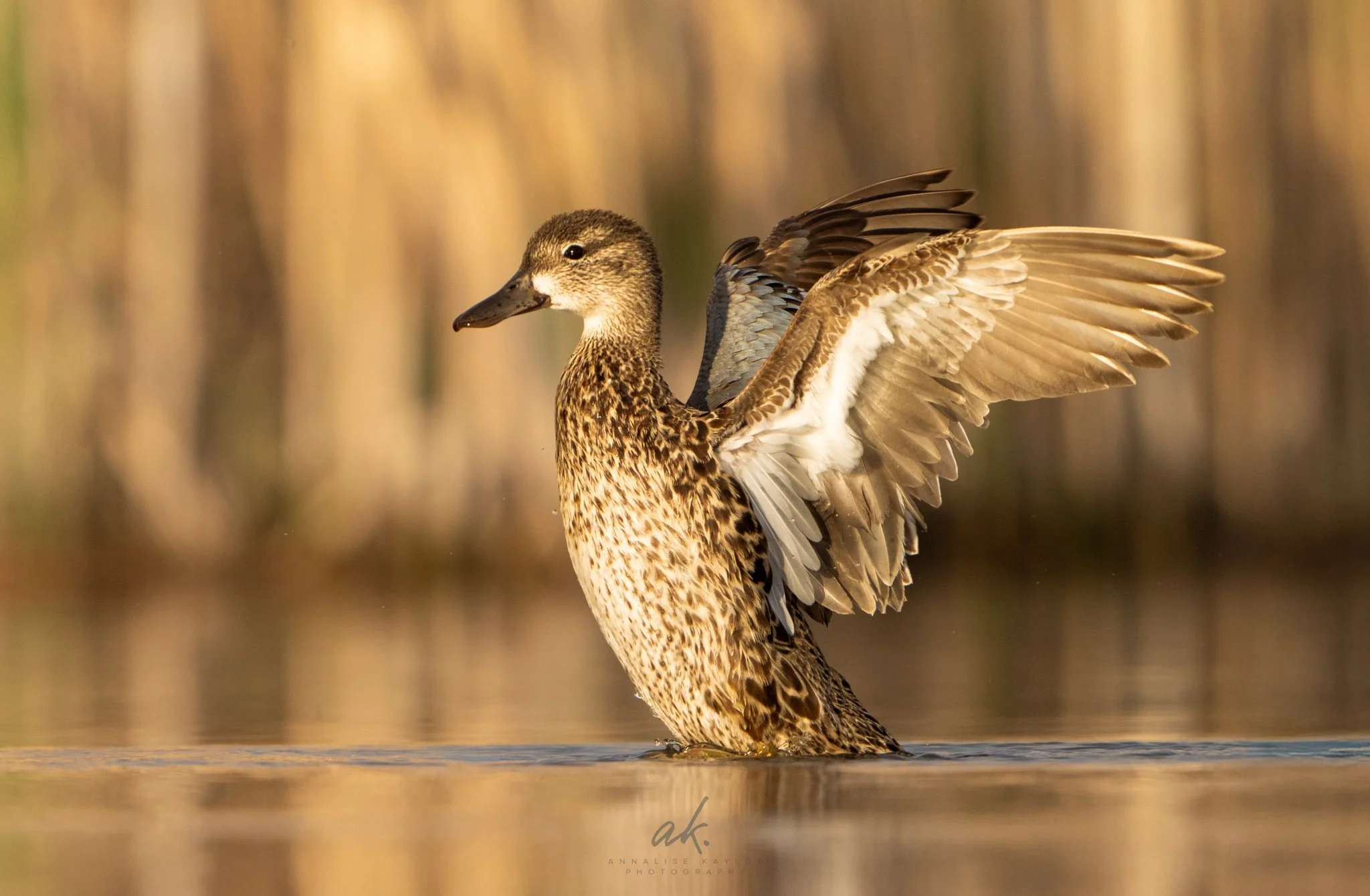
A hen blue-winged teal (Spatula discors) stretches her wings before resettling in the water. Overlooked by many because of their drab colors designed around camouflage, a close look reveals their subtle blue patch on their wings.
This, to me, is the marrow of wildlife photography. Many wildlife photographers can take a photo, but few earn it.
It’s understanding the habitat and the histories braided into it. It’s recognizing that the prairie potholes are not just a backdrop for birds, but the very reason they exist here—geology drives biology. Shaped by retreating glaciers nearly 10,000 years ago, this region now hosts more than half of North America’s breeding waterfowl. It is, biologically speaking, one of the most productive landscapes on the continent. But it asks something of you: time.
You can’t pass through this country quickly; it won’t show you anything if you do. There’s a humility in that.
Out here, my best photos came when I stopped thinking about taking photos altogether. When I was simply there—present, alert, immersed. A muskrat passing so close I could hear the sound of its breath. Two eared grebes rising in tandem to dance in a syncopated rhythm that splashed my lens. A redhead drake floating through the stillness of the morning fog.
None of those moments came from technical mastery. They came from waiting.
I often say—and mean it—that if you want to be a better photographer, you have to become a better naturalist first. Know the birds, not just their names but their stories. Know their courtship, their rivalries, their nesting habits and food preferences. Know the seasons of the land they return to. Know which ponds hold the right aquatic plants for blue-winged teals, and which edges the shovelers prefer. Know when to hold still because a moment is building, and when to let it go because the birds already have.
We spend so much time as photographers obsessed with the idea of control—controlling light, controlling composition, controlling noise. But the floating blind teaches that the most powerful work happens when you relinquish control. When you give yourself over to a place, a rhythm, a silence. When the camera stops being the center of the experience and instead becomes a witness to it.
This is not easy work. It’s physically demanding, unpredictable, and often unrewarded in the conventional sense. But it reminds us of the difference between looking at wildlife and being with it. Of the difference between making an image for the dopamine hit of social media “likes” and of making an image for the dopamine hit of one’s individual, fleeting, momentary experience. That in the end, the best images are not made, but offered.